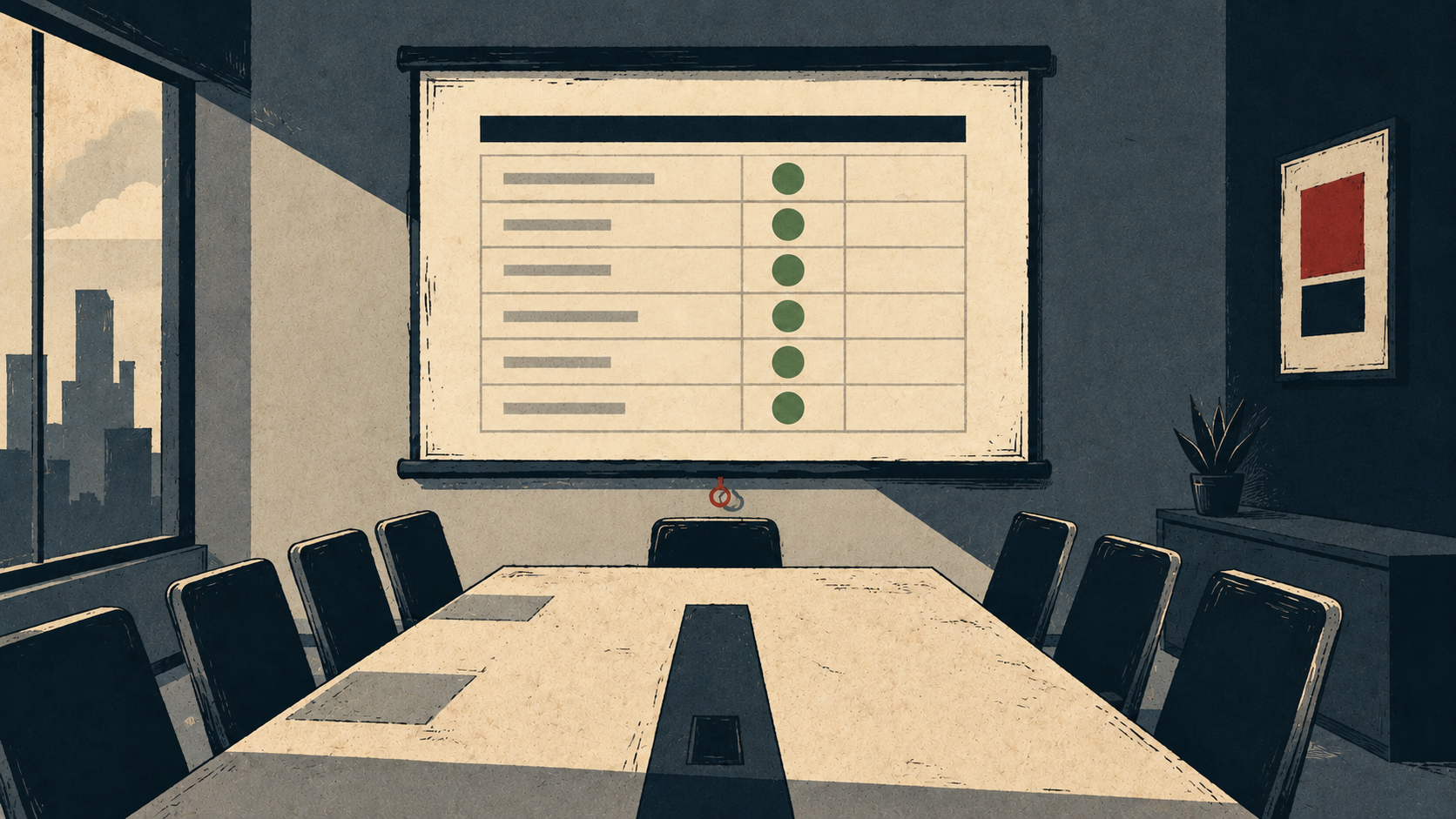
A green status is supposed to create confidence. It tells people that the work is on track, the risk is under control, and the plan can continue as is. That confidence turns dangerous once the status starts answering a different question than the one people think they’re getting an answer to.
There’s an obvious version of this problem that most people already recognize. A project is off track, but someone reports it as on track anyway. The real condition might be closer to red, yet it shows up on the report as yellow, or the real condition is yellow and it gets written down as green. Whoever is giving the update may be trying to avoid scrutiny, calm down a nervous executive, protect a relationship with a client, or simply buy a little more time before admitting how bad things have actually gotten.
That version is easy to understand, because the report is directly making the work look healthier than it is. But the harder version to spot is the one where pressure inside the company changes what the status is actually supposed to mean.
In that version, green stops proving that the work is ready, approved, stable, and safe to keep moving. Instead, it starts proving something else entirely: that the business still has a path to the revenue it’s hoping to collect, the paid hours it needs, the signed work it’s hoping to land, and a fuller schedule. The spreadsheet gets updated, the report looks positive, the dashboard shows stability, and the status flags appear disciplined. Yet the work underneath is still carrying real risk.
That is the green status lie at the center of all this. The problem isn’t a lack of information. It’s that the information may be answering the wrong question entirely.
The Tools Themselves Are Not the Problem
Management tools exist to help a company see what’s happening before problems get harder to fix. Status reports, sales projections, billable-hour targets, and resource plans can all do real work when they help leaders understand the condition of the project and the condition of the business at the same time.
Beyond The Surface
The thing that is easiest to see is not always the best explanation for what is happening. Look beyond the surface. Consider what allowed it to develop, what keeps it in place, and what the surface explanation leaves out.
A good status report helps people catch problems early, decide what needs attention, and avoid the kind of surprise that only shows up after a deadline has passed, a budget has been blown, or a client relationship has already taken damage. The colored flags attached to a status (green, yellow, red) earn their keep when they actually show where work is safe, where it needs a closer look, and where it’s already in trouble.
The same logic applies to sales projections, which are simply estimates of work the company expects to sign in the future, and to billable-hour targets, which track how many hours of paid client work the company expects its people to complete. A company genuinely needs to know whether enough work is coming in, whether it has enough people available to do that work, and whether its current plan lines up with the money it needs to keep running. None of those questions are shallow on their own. They’re part of running a business responsibly.
Resource planning earns its place too, when it simply means deciding which people should do which work, in what order, and whether the timing actually makes sense. The people closest to a project belong in that conversation, because they’re the ones who know which work is truly ready to start, which decisions from the client are still missing, and which assignments are likely to create conflict. When those voices stay connected to decisions made at the top, reporting becomes more than a spreadsheet update. It becomes a way of checking the business plan against the real condition of the work.
The trouble starts once those same tools stop testing the condition of the work and start protecting the number the business wants to hit. The reports can still look disciplined on the surface, but the questions driving them shift away from whether the work is healthy and toward whether the numbers can still be made to add up.
The Wrong Signals Start Defining the Status
A reporting system can still look disciplined even as what it’s actually measuring changes underneath it. Status markers get reviewed, projections get updated, and resource plans look organized, but the meaning behind those updates shifts. Rather than showing whether the work is finished, approved, or stable, the report starts showing whether the company can still squeeze revenue out of it.
That shift can make the reporting look just as useful, even though what counts as useful information has narrowed. Work targets get split across teams, departments, or individual people until the plan appears to show enough paid work for everyone. Estimates of future revenue stay in the plan even after the actual signed work has fallen behind. The spreadsheet still shows progress, but a lot of that progress now comes from projected sales, possible future work, and client decisions that haven’t been made yet, rather than from work that’s confirmed and ready to go.
“Once the target gets treated as the fixed point everything else has to bend around, every other signal starts getting judged by whether it helps keep that target alive.”
That is the green status lie in its simplest form. Project health gets replaced by projection, and what is actually happening right now matters less than what future business might arrive to help the company hit its financial goals.
This is also where different versions of the truth inside a business start getting flattened into one report. Leadership has a target it wants to hit, finance can show what has actually been signed, billed, collected, or missed, and sales can describe what might still close or what a client may agree to next. Meanwhile, the delivery teams know which tasks are genuinely ready, which decisions are still missing from the client, and which risks are not being raised.
When those versions don’t match, the reporting system has to decide which one carries the most weight. In a healthy system, the gap between them becomes the very thing that gets managed. In a distorted one, the target itself becomes the truth everyone else is expected to organize around.
Once that happens, status starts answering a business question before it answers a project question. The report can still look organized, but the organization underneath it is now pointed at a narrower version of health.
Planning Turns Into Pressure
The shift happens once the numbers stop describing the work and start demanding that the work bend to fit them. A monthly target usually creates that pressure first, especially when it keeps climbing or never adjusts after the actual signed work has fallen short. Once that gap shows up, the report no longer just shows what’s happening. It starts showing what needs to be moved, pushed, started, or sold so the month still adds up on paper.
Reality Check
When a company measures project health against the target it wants to hit instead of the evidence that the work is on track, on time, on budget, within scope, and strong enough to continue, reporting becomes a way to protect the preferred story. The report can look safe to executives while the project, the client relationship, and the future work attached to it are carrying unresolved risk. The practical result is a green status lie that protects reputations and short-term comfort now while pushing the real consequences into later.
That pressure doesn’t stay contained to a conversation among leadership. It travels down into project management, into department leadership, and eventually into the people actually doing the work. A target coming from above turns into a staffing question, then a scheduling question, then a question about how hard to push a client. The business may genuinely need more hours of paid client work, but the team on the ground receives that need as a request: assign someone, start something ahead of schedule, push for a faster approval, or turn a future phase of work into something happening right now.
That changes what planning actually means. A process whose purpose is to match people with work that’s ready for them turns into a search for empty hours that need filling. Someone without enough paid work on their plate becomes a problem to solve, even when there isn’t any ready work to give them. Work scheduled for a later month starts looking tempting to move forward, since pulling it into the current month makes that month look healthier — even if the client hasn’t approved enough of it, the team still lacks clear direction, or starting early just creates more cleanup down the road.
When those moves appear to close the gap, the organization can feel like it’s back to green. But that green status rests on hopes and projections being treated as settled fact. The work itself hasn’t necessarily gotten any healthier. The business has only found a way to make its target look reachable again.
The questions that matter most tend to get pushed aside in this process. Is the work actually good? Is the client getting the attention they deserve? Does the work make the company look like genuine experts, or like a vendor scrambling to fill out the month? Those questions still matter, but they lose their force once the report keeps circling back to the one number that has to come out true.
Green That Rests on the Wrong Kind of Proof
None of this means status flags themselves are useless; the real pattern is that a status becomes unreliable once it gets attached to the wrong kind of proof. A green status can rest on completely real information and still fail to answer the one question that matters most.
That’s the part managers often miss. The issue isn’t whether a number exists, whether a person has been assigned to a task, or whether a future sale might come through. The issue is whether those facts actually prove the work can keep going responsibly. If a status is built on possible revenue, fuller schedules, or client decisions that haven’t happened yet, the organization is measuring motion before it measures the actual health of the project.
“The shift happens once the numbers stop describing the work and start demanding that the work bend to fit them.”
When several different versions of business truth compete inside the same report, the version most likely to get rewarded is usually whichever one keeps the target alive. What finance can confirm, what sales is hoping will close, the pressure coming from executives, and the real risk to the work being delivered to the client — these can all be present at once, but they rarely carry equal weight. Once the target gets treated as the fixed point everything else has to bend around, every other signal starts getting judged by whether it helps keep that target alive.
This is where fear and scarcity start shaping what gets written into the report. The organization stops acting from confidence in the work, in the client relationship, and in the judgment of the people closest to actually doing the work for the client. Instead, it starts acting as though the number has to be protected first, with everything else expected to adjust around it.
This is also how the system-level version of the green status lie can end up breeding the more direct, hands-on version of the same lie. Once confident projections start getting rewarded, people learn to adjust their inputs before a report gets reviewed, so the outlook looks stronger than they actually believe it is. The spreadsheet might show more confidence, a better expected revenue number, or a smoother path to the target, even while the person typing in those numbers knows the work behind them is far less certain.
The lie lives in what green is allowed to count as proof. Green doesn’t become misleading only when someone changes a status by hand. It becomes misleading once the system decides the wrong evidence is good enough, and then teaches people how to make that evidence look better.
How Managers Can Read the Signal
Managers can usually spot this problem by paying attention to what the report actually asks people to prove. If a review mostly rewards updates about closing deals, pushing clients toward a decision, assigning more hours, or protecting the month’s target, then what’s being measured is mostly business pressure rather than the health of the work. Those questions can matter in their own right, but they shouldn’t be allowed to stand in for the condition of the work itself.
What to Remember
- A green status becomes unreliable when it is measured against the business target the company wants to hit instead of the evidence that the work is on track, on time, on budget, within scope, and healthy enough to continue.
- When a report treats possible sales, projected hours, and hoped-for client decisions as if they are already real, it stops showing project health and starts protecting the version of reality the company wants to see.
- When organizations reward protecting the target over surfacing the real condition of the work, teams learn to make the report look stable before the work itself is stable.
- A green status lie protects short-term comfort, reputations, and internal confidence while pushing unresolved project risk into the future.
A better way to read a status starts with the evidence behind it. A manager should be able to say whether green means the client has actually approved what’s needed, the team has enough direction to move forward, the timing makes sense, and the risks everyone already knows about have genuinely been handled. When those answers are missing, the status may only be telling you that activity is still happening, not that the work is actually in good shape.
The same test applies to resource planning, which is the process of deciding who works on what and when. The real question isn’t only whether someone can be assigned to more paid work. It’s whether that person is being handed work that’s actually ready for them, in a sensible order, with enough information to avoid creating bigger problems later on.
Managers should also pay attention to where pressure first enters the report. Does the reporting keep what leadership wants separate from what finance can confirm, what sales believes might happen, and what the team can realistically support? Or do all of those get collapsed into one version of reality, the one where the preferred target wins out?
The warning sign isn’t a busy team, a full schedule, or an optimistic update on its own. The real warning sign is a report where unresolved risk keeps getting converted into motion, and that motion then gets treated as proof the risk has already been handled.
What Status Teaches People to Say
A status system does more than report what’s happening; it also teaches people which kind of answer feels safest to put into the report. When the strongest attention goes to signed work, possible sales, filled hours, and fuller schedules, teams learn over time to make those particular signals look stable first.
That doesn’t make every green status dishonest, and it doesn’t make every forecast, sales target, or hour plan useless either. The issue is simply that a management system can count the wrong things with real discipline and still produce confidence before the work has actually earned it.
The green status lie isn’t always a lie someone tells on purpose. More often, it’s the result of a system that counts motion, rewards confidence, and pressures people to turn uncertainty into something that looks like a plan. Once that pressure repeats long enough, optimistic reporting can start to feel less like distortion and more like simply going along with how things work.
A green status should be a sign that the work is healthy enough to keep going. Once it becomes a sign that the business has found a way to keep its target alive instead, the status has stopped protecting the work and started protecting the story.